
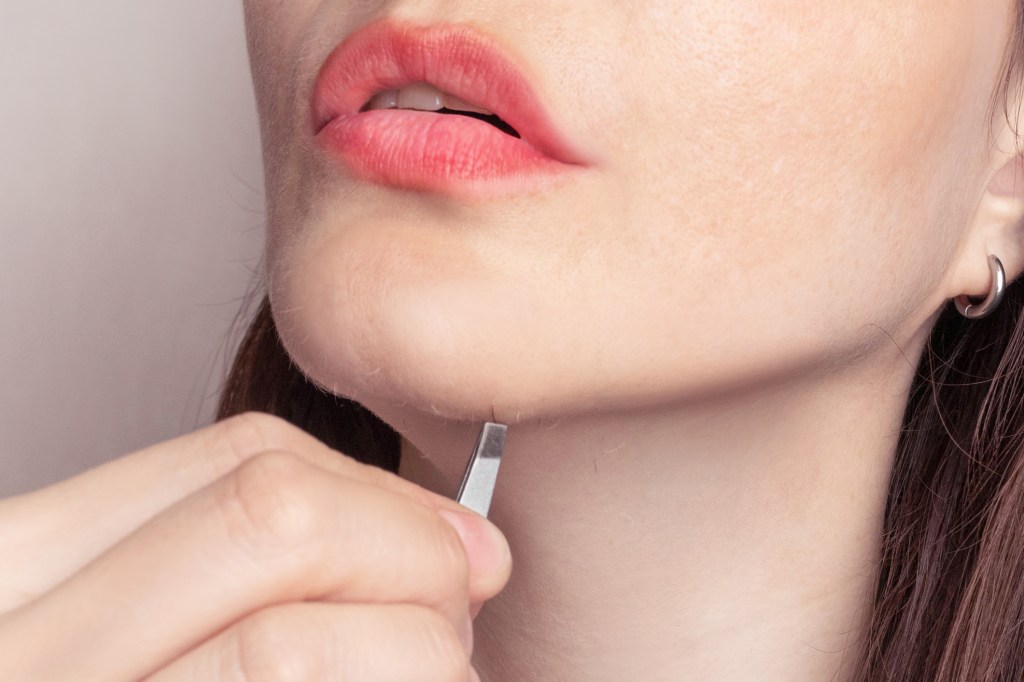
Whilst many women talk openly about their menopause symptoms, there’s one that very few care to admit, even though it is very common. And that is facial hair, specifically on the chin. To everyone who has that pesky stubborn hair that seems to grow back the minute you pluck it, you are far from alone. Discover why you get those thick wiry hairs and the best way to handle them.
Pics: Getty Images
It’s one of the less glamorous signs of getting older and although only visible to you, chin hairs can prove to be a nuisance. Even I’ll admit to buying a magnifying mirror to remove the occasional chin hair: that dark, deeply offensive sharp piece of stubble that announces itself without warning. In fact, that pesky chin hair that feels victorious when you pluck it out can also prove to be a constant battle between you and it: the next day it’s back, occasionally bringing a few follicle friends along with it. Although many women see the funny side of having a “beard” it’s no laughing matter so we have asked two medical experts about why we get chin hairs and what the best way is to remove them.
The battle with chin hairs
Physician Jennifer Gularson, of Your Best Life with Jennifer – who focuses on hormone health for women in midlife – has seen a fair share of facial chin hairs on her patients.
“Nobody warned us about this part. The hair on your head is thinning, your eyebrows are quietly packing their bags, and meanwhile your chin has apparently decided to grow a beard,” she explained. “Menopause has a sense of humor, and it’s not always a nice one.”
So what exactly is causing chin hairs to appear?
“As estrogen drops, testosterone and the other androgens get more of a say. Your testosterone isn’t necessarily going up. Estrogen just isn’t around to keep it in line anymore, and the protein that normally holds on to these hormones in the blood (SHBG) drops too, so more testosterone is free to wander around and cause trouble. The follicles on your chin and upper lip are the most androgen-sensitive of the bunch, so you may see them increase first. That soft peach fuzz you’ve always had gets more noticeable, and a few follicles start sprouting thick, dark, wiry hairs that seem like they belong to somebody’s grandfather,” she explained.
All of this however is common she explains, adding women bring it up in her office all the time.
“They usually say it in a whisper, like they’re confessing something. I joke that I’ve put my daughter in charge of chin-hair patrol. There is nothing quite like looking in the mirror one morning, finding a long, dark hair on your chin, and thinking, “Was that there yesterday? And if it wasn’t, how did it get that long overnight?
“And if you’ve ever spotted one in the rear-view mirror at a red light, you know a very specific kind of horror.” I’m sure many women can attest to this!
“As for the idea that plucking one makes five more grow back, I promise it doesn’t. It just feels like a conspiracy. Every follicle runs on its own schedule, so while you’re busy hunting down the one hair you spotted, its neighbors are quietly starting their own growth phase. The only real downside to plucking is irritation or ingrown hairs, so if you tend to get bumps, try something else.”
NIKON D800 · f/5 · 1/100s · 52mm · ISO800
Testosterone and hair – can it be to blame?
As someone on testosterone cream myself, I’m aware that it can make women hairier but Jennifer Gularson says whilst it gets a lot of the blame, for most women it’s not the culprit if her levels are being managed appropriately.
“I see plenty of chin hairs on women who have never touched a hormone. That said, testosterone therapy can make some women hairier, especially if the dose is more than their body needs. If you’re using it and notice coarser, darker hairs on your face or more body hair, don’t panic and don’t just quit. Talk to your provider about your dose and your levels so you stay in a normal female range. Also pay attention to where you’re putting it. Hair can grow right where you apply it, so rotate spots, keep it well away from your face, and wash your hands after. Nobody wants a hairy forearm souvenir.”
And although it is easy to blame everything on menopause, there could be another reason your chin is sprouting hair and that is if you are someone taking oral minoxidil.
According to Jennifer Gularson, more and more women take a low dose of the medication for thinning hair, and it can work beautifully, but it doesn’t know we only invited it to grow hair on our heads.
“Some women end up with extra peach fuzz on the face or more hair on their arms and legs,” she added. “On the flip side, medications like spironolactone or finasteride turn down androgen activity and can help with unwanted hair. Finasteride isn’t safe if there’s any chance of pregnancy, though, and I’m not a fan of piling on one medication just to cancel out the side effects of another. That deserves a real, individual conversation, but bottom line, there is hope out there.”
Ways to get rid of unwanted chin hairs
As for getting rid of chin hairs, don’t overlook following your partner’s routine by using a razor; something Jennifer Gularson herself admits to doing.
“Personally I use a ladies razor once or twice a week. Just one quick swipe and the fuzz is gone. Plus it can work as an exfoliator as well, call it a cheaper version and a dermaplane!
“And good old tweezing can work, as well as threading, waxing and dermaplaning, depending on how many chin hairs you’re dealing with and how much patience you have.”
Many women I know opt for laser hair removal; although having tried it myself and given up – you need to see the process through.
“Laser is great for dark hairs because it targets pigment, but it only works on hairs that are in their active growth phase, and only a fraction of your hairs are growing at any given time,” explained Jennifer Gularson. “The rest are just hanging out, waiting their turn. So you’ll need multiple treatments to catch every hair that could be growing in that area. It’s not a one-and-done, just keep that in mind. The other catch is that once those hairs go gray or white, the laser can’t see them anymore, which feels like adding insult to injury. That’s where electrolysis comes in. It doesn’t care what color the hair is, and it’s the only method that gets rid of hair permanently.
“Something to keep in mind, a few new chin hairs in midlife are completely normal. But if facial hair shows up suddenly and a lot of it, or it comes with bad acne, thinning on your scalp or a deeper voice, that’s not just menopause or perimenopause acting up. Get it checked.”
Why chin hairs in midlife women is common
Mindy Goldman, Chief Clinical Officer at the US-based virtual healthcare platform Midi Health reassures women that chin hairs are very normal in midlife.
“It’s very common for women to notice a few new coarse hairs on the chin or upper lip around
. It’s not usually because women suddenly start making more testosterone. Rather, estrogen declines much more dramatically than testosterone during the menopause transition, creating a relative shift toward androgen, or testosterone-like, effects. Hair follicles on the face can be particularly sensitive to these hormonal changes, which is why those occasional coarse hairs can start appearing,” she adds.
Canon EOS R10 · f/8 · 1/60s · 24mm · ISO800
“Testosterone can cause increased facial or body hair, but this is uncommon when it is prescribed at appropriate female doses and blood levels are maintained within the normal premenopausal range. That’s one reason we monitor testosterone levels and symptoms during treatment. If a woman begins developing noticeable facial hair, acne, or scalp hair thinning, it may be a sign that the dose needs to be adjusted.
“What is worth paying attention to is a significant or rapid change. A few chin hairs that gradually appear in midlife are very common, but suddenly developing a lot of coarse facial or body hair is different. If that happens, particularly along with significant acne, scalp hair loss, a deeper voice, or other noticeable changes, it’s worth talking with a clinician to make sure there isn’t another cause.”
Now you have all this information to hand, don’t be embarrassed if there comes a point when your bathroom mirror is no longer where you just brush your teeth and put your make-up on in front of. The fact it can occasionally resemble a crime-scene investigation with your magnified mirror and set of tweezers is more common than you think. Remember you are amongst a vast majority of women waging war on a pesky chin hair or two so we are all in it together!
—